You sign your first wholesale account. The buyer requests trade pricing, a 24-unit minimum, and an invoice. In Shopify, the available wholesale settings can make it appear that these features require Shopify Plus and its higher cost.
The good news is that this assumption is outdated. You can run real Shopify wholesale without Plus, on the same store, for the same customers, using tag-based customer-group pricing. The plumbing that makes it work, Shopify Functions, runs on every paid plan. This guide explains exactly how, what the native tools now give you for free, what still requires Plus, and how to stop a wholesale buyer from being charged the retail price by mistake.
🎯 Quick Summary
- You do not need a Shopify Plus plan for wholesale. Tag-based B2B pricing runs on Shopify's Discount Function, which works on Basic, Shopify, and Advanced.
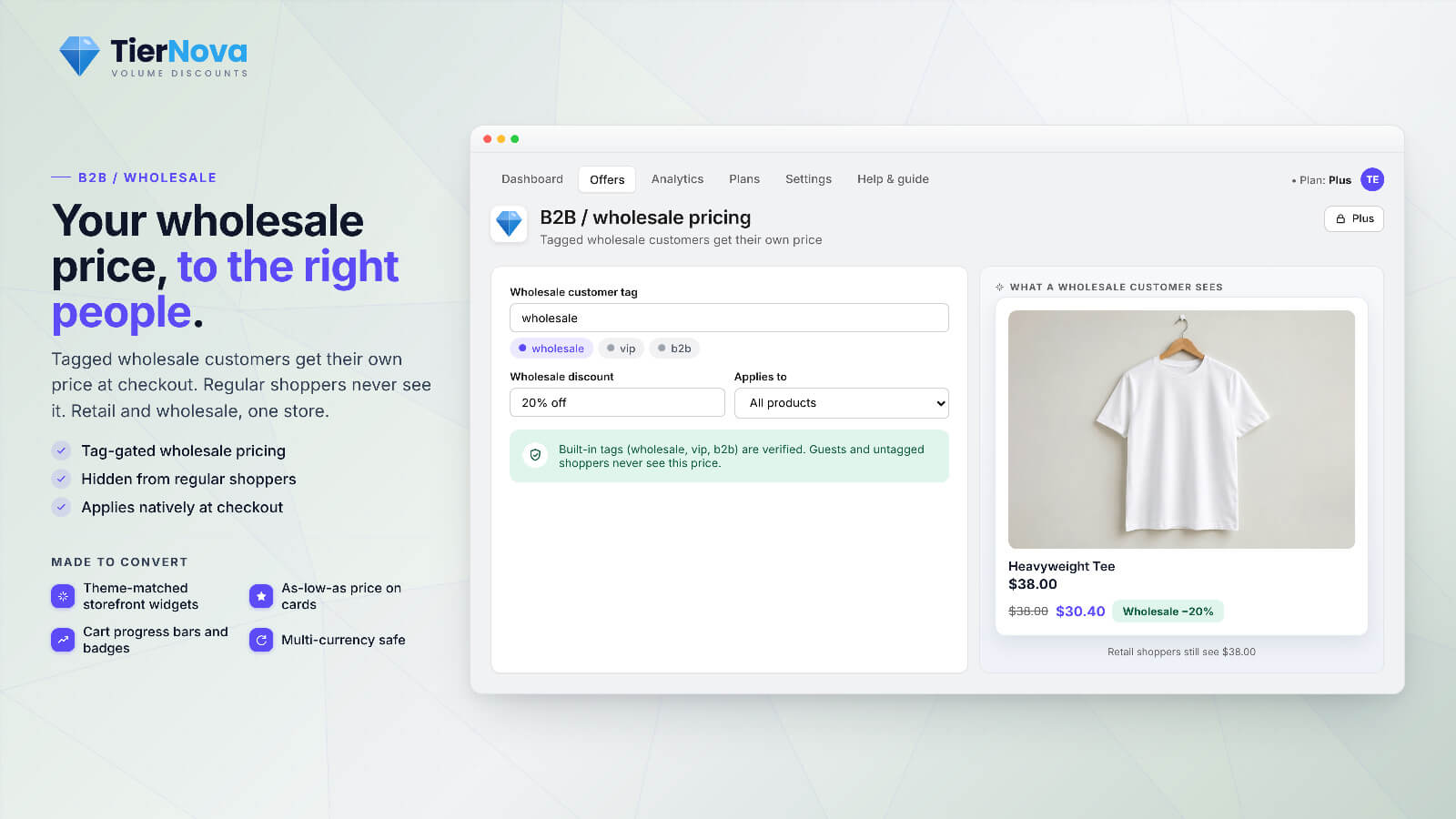
- You tag wholesale customers, they automatically see their B2B price, and retail shoppers see normal prices, all on one storefront.
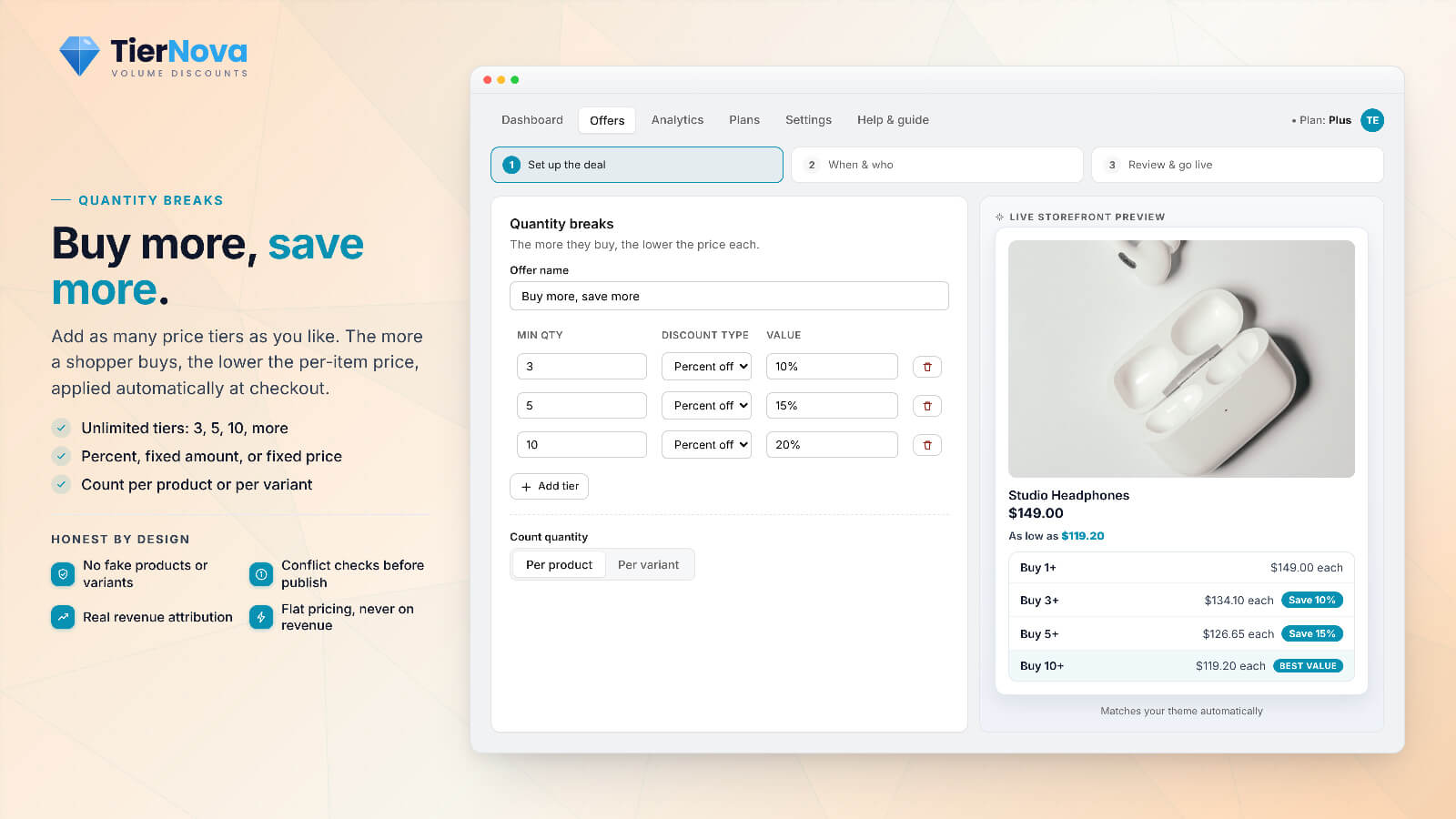
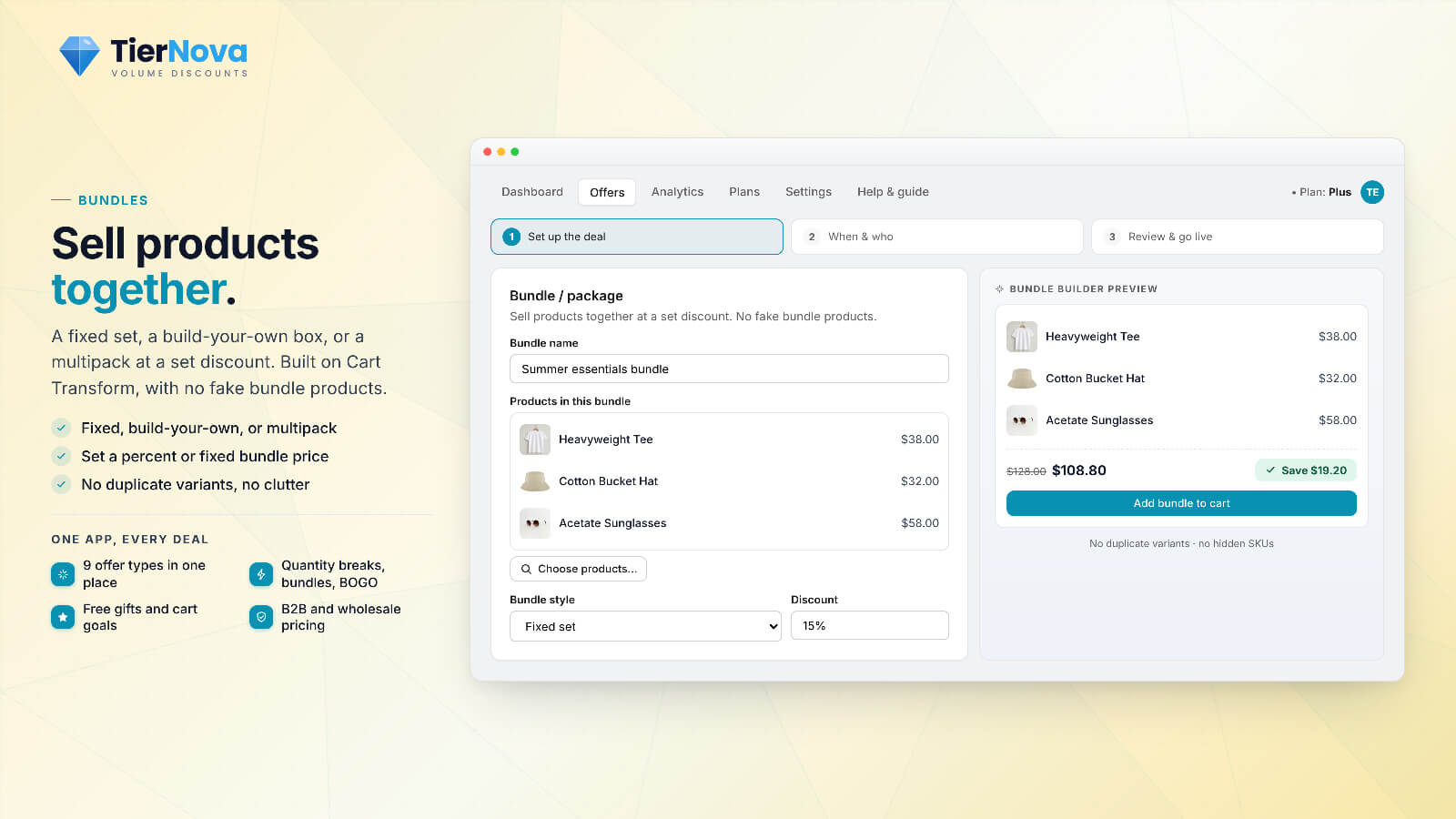
- The biggest B2B gap is being forced to pick wholesale OR a discount. TierNova recalculates the whole cart so wholesale price, volume breaks, and group pricing can combine.
- Order minimums (MOQ), even at express checkout, are enforced with a Validation Function, and a wrong-price guardrail alerts you if a wholesale customer is about to be charged retail.
🔍 Do You Need Shopify Plus for Wholesale?
The short answer is no. The misconception comes from a time when the main official wholesale options were a Plus-only channel or a separate custom B2B storefront. As a result, smaller merchants sometimes paid for a second storefront or a Shopify Plus upgrade simply to offer trade pricing to a limited number of accounts.
What changed is the engine underneath. Shopify Functions run server-side and are available to public App Store apps on every paid plan. A wholesale app can read a customer's tags inside the Discount Function and apply a different price to a tagged group. So customer group pricing on Shopify stopped being a Plus privilege and became something any store can do.
One important distinction: With TierNova, the wholesale and B2B feature is included in TierNova's own Plus tier at $74.99/mo. That is TierNova's pricing tier, not Shopify's. Your store can be on Basic, Shopify, or Advanced and the wholesale pricing still works. You pay TierNova for the feature, not Shopify for a plan upgrade.
⚡ How Tag-Based Wholesale Pricing Works
The system is based on a standard Shopify concept: the customer tag. A tag is just a label you stick on a customer record, like wholesale or vip-trade. Here is the flow, start to finish.
1. You tag the customer. Approve a trade account and add the wholesale tag. That is the only switch that decides who gets B2B pricing.
2. The Function reads the tag. When that customer is logged in and shopping, TierNova's Discount Function checks their tags on Shopify's servers and applies the matching B2B price. No discount code to type, no separate portal to log into.
3. The right price shows everywhere. Because it runs as an automatic discount, the wholesale price holds up in the cart, at checkout, in Shop Pay, and in express checkouts. Retail shoppers without the tag see your normal prices. Both groups use the same store and pricing engine.
There is one implementation detail to note. Shopify's newer customer segments cannot be read inside a Function; only tags can. So if you prefer to target by segment, TierNova maps a segment to a tag automatically in the background. That means segment-style targeting still works on every plan, without you having to hand-tag people one by one.
How tag-based B2B pricing flows
Tag
Add a wholesale tag to the approved customer. That single label decides who gets trade pricing.
Function
Shopify's Discount Function reads the tag server-side and applies the matching B2B price.
Checkout
The wholesale price holds in cart, checkout, Shop Pay, and express wallets as an automatic discount.
Guardrail
A check verifies the price landed and alerts you if a wholesale buyer was about to pay retail.
🧩 Wholesale, Sales, and Codes in One Cart
This is a common limitation in wholesale tools and a frequent source of merchant frustration. The classic B2B gap is being forced to choose: a customer gets either their wholesale price OR your quantity discount OR the seasonal sale, but never a sensible combination. A trade buyer may therefore receive the sale price instead of the wholesale rate, or the reverse.
TierNova handles this by recalculating the whole cart rather than applying one discount and stopping. A wholesale base price, volume breaks, and group pricing can combine, and when configured to do so, the customer receives the better of the sale price and wholesale price rather than whichever discount was applied first. Codes and automatic discounts co-exist instead of canceling each other.
If you have ever watched a discount look right in the cart and then evaporate at checkout, that is a related and very common problem. We pulled apart the causes in why your Shopify discounts fail at checkout and how to fix them, and the same native-engine approach helps keep wholesale pricing applied at checkout.
Volume breaks are a natural partner to wholesale, since trade buyers order in quantity. If you want to design tiers that cascade correctly past the top break and stack cleanly with a wholesale rate, our complete guide to volume and quantity discounts on Shopify explains the tier calculations in detail.

Wholesale pricing without the Plus bill.
TierNova runs tag-based B2B pricing on Shopify's native engine, stacks it with sales and volume breaks, and alerts you if a wholesale buyer is ever charged retail.
📦 Order Minimums (MOQ)
Wholesale programs often include a minimum order value, minimum quantity, or collection-level minimum (for example, 12 units per style). TierNova enforces these with a Shopify Validation Function, which also runs on all paid plans.
The important detail is where the rule is checked. A weak MOQ setup only validates on the cart page, which a fast buyer can skip by going straight through Shop Pay or another express checkout. TierNova's validation runs at checkout too, including express checkouts, so a wholesale buyer cannot slip under your minimum by taking the quick path. The minimum holds no matter how they pay.
| Capability | Shopify native alone | TierNova |
|---|---|---|
| Wholesale pricing without Shopify Plus | Partial (native B2B basics) | Yes (tag-based, all plans) |
| Wholesale price + sale or volume break in one cart | No | Yes (recalculates whole cart) |
| Segment-style targeting inside a Function | No (segments unreadable) | Yes (auto-maps segment to tag) |
| MOQ enforced at express checkout | No | Yes (Validation Function) |
| Wrong-price alert if a buyer is charged retail | No | Yes (guardrail + alert) |
| Multi-currency safe wholesale rates | Partial | Yes (percentage by default) |
🚀 Native B2B Now vs What Still Needs Plus
Shopify itself has moved a lot of B2B down-market, which broadens access to native B2B features. Since April 2, 2026, native B2B on new Shopify Markets is available on all plans, not just Plus. That includes company accounts, up to 3 market-level catalogs, quantity rules, and net payment terms. For many small wholesale operations, that alone covers the basics.
A few things are still reserved for Plus: unlimited B2B catalogs, per-company price lists, deposits, and B2B abandoned-cart emails. And for fully custom, one-off quotes on a non-Plus plan, draft-order invoices remain the practical fallback. TierNova is designed to sit alongside all of this, integrating Shopify's native Catalogs and Price Lists where they are available rather than conflicting with them.
So the honest framing is this. Native B2B gives you the structure (companies, catalogs, terms). A wholesale app like TierNova adds the flexible pricing logic on top: tag-based group pricing that combines with sales and volume breaks, MOQ enforcement that holds at express checkout, multi-currency rates that default to percentages to dodge foreign-exchange rounding bugs, and the wrong-price guardrail. They are complementary, not competing.
💡 Pro tip: Multi-currency wholesale is where fixed amounts cause unexpected problems. A flat "$5 off" can round badly once it is converted across markets. TierNova defaults wholesale to percentage discounts and stays Markets-aware, so a 20 percent trade rate stays 20 percent in every currency instead of drifting by a few cents.
🛠️ How to Set It Up
The setup uses a guided wizard rather than a custom development project. Here is the short path to launch.
- Install TierNova and pick the wholesale template. The guided wizard starts you from a B2B preset instead of a blank screen.
- Define your group. Choose the customer tag (or a segment, which TierNova maps to a tag for you) that identifies your trade buyers.
- Set the price rule. A flat percentage off, fixed B2B prices, or tiered wholesale by quantity. Percentages are the safer default for multi-currency.
- Add an MOQ if you need one. Set a minimum order value or quantity, by collection if you want, and it is enforced through checkout.
- Turn on the wrong-price guardrail. This ensures you are alerted if a wholesale customer is about to be charged the retail price.
- Tag a test customer and preview. Confirm the trade price shows in cart, checkout, and Shop Pay before you invite real accounts.
One timing note worth flagging: TierNova includes one-click Scripts migration for wholesale rules that stopped working after June 30, 2026. If your current wholesale pricing is implemented in older Scripts, our Shopify Scripts migration guide covers the move. And if you would rather have someone set the whole B2B flow up for you, the CartWorks services page explains how a full store optimization engagement works.
The key point is that wholesale on Shopify is no longer limited to Shopify Plus. Tag a customer, let the Function do the pricing, keep your minimums and your margins honest with a guardrail, and run trade and retail from one clean store.
Frequently Asked Questions ❓
wholesale to the customer record. When that logged-in customer shops, the Discount Function recognises the tag and applies their B2B price automatically in the cart and at checkout. There is no code to enter and no separate login portal. Retail visitors without the tag simply see your normal prices.